


UPDATE: The details have emerged!
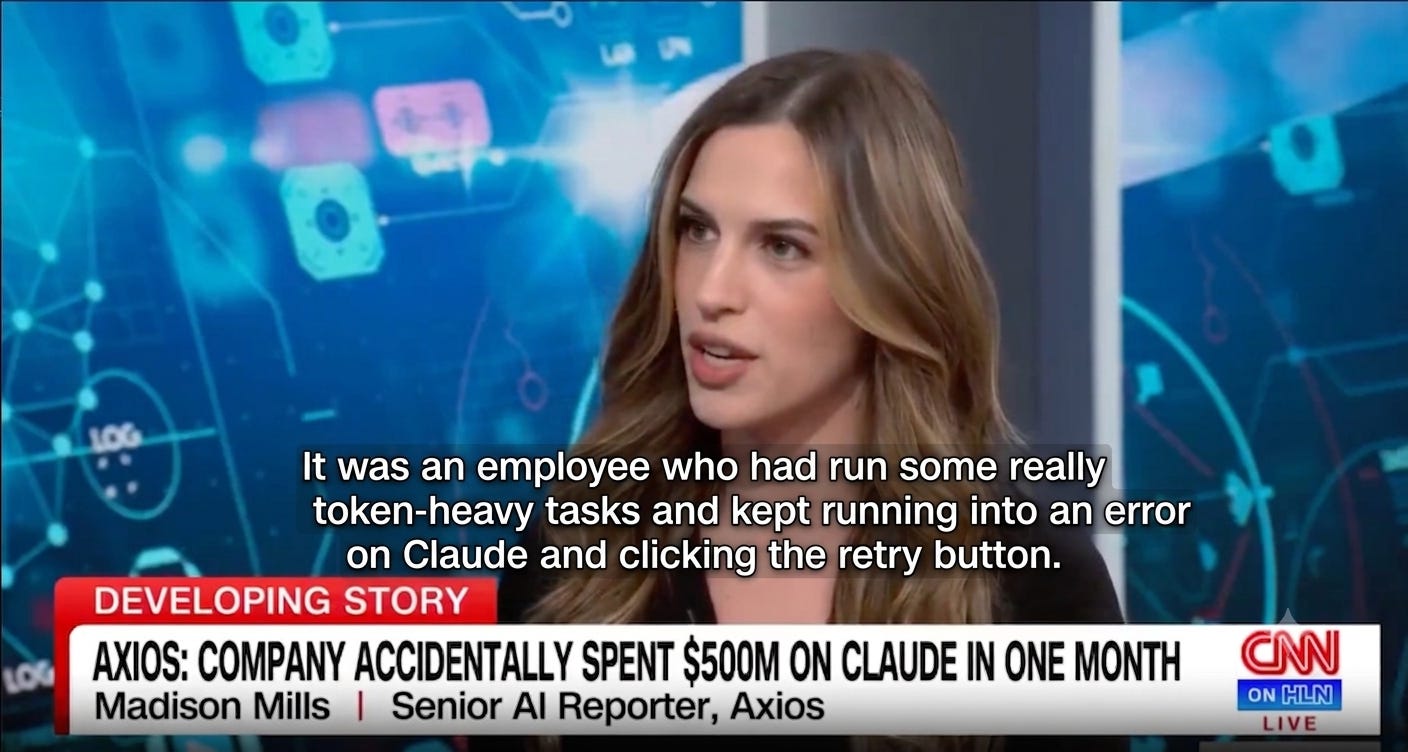
“It was an employee who had run some really token-heavy tasks and kept running into an error on Claude and clicking the retry button over and over and over."
Madison Mills on CNN.
One can only admire the chutzpah. Going on CNN to discuss a totally fictitious event and doubling-down with an even more absurd lie. Either the source found a simpleton to dupe, or she truly belongs on The Wire (Season 5).
Watch in disbelief for 30 seconds below…
This came out after I published the below. The signs were there already…
The $500M Fat Finger
The Claim
Corporations have been bled dry by AI token bills and have not a thing to show for it. So the hive mind of media coverage decreed at the end of May.
The pinnacle was Madison Mills’s scoop for Axios, and it contained a single sentence that reverberated around the world:
“An AI consultant tells Axios one of their clients recently spent half a billion dollars in a single month after failing to put usage limits on Claude licenses for employees.”
Joyous vindication for the sceptics. Anthropic’s mask has slipped and Enterprise is getting out. The models do not work, the prices are an obscenity, and with this scoop, the game may be up.
Those Numbers End The World
$500M in a single month is, in the modern parlance, $6B of ARR.
Anthropic’s ARR was likely about $36B that month. Seems a fat finger is allegedly accounting for a sixth of it.
Roughly 33T tokens. 5% of global compute.
That is the workload of a nation state.
Big if true…
Before We Head For The Bunkers
None of this happened.
Why It Is Financially Impossible
I am not a stranger to usage-based billing. Anthropic did not invent it. That is simply cloud computing, and I spent six and a half years as a startup CFO keeping my fingers crossed when the AWS bill would be each month.
It crept, as these things do. $800 a month seemed spenny at the start. Just kept rising and nothing could be done. When it got to $80k a month and suddenly they had pulled Snowflake and Databricks random billing on me too.
I stormed over to the devs and told them enough was enough! They need to stop playing with instances all day and ship more product!
Well turns out we needed more and usage-based pricing was the new game.
We installed checks and balances after that. Everybody does, because a usage-based bill without a cap could blow up the company/
A company large enough to plausibly absorb a $500M surprise has 100s of beancounters.
The idea that such an organisation uniquely forgot to tick the 'limit’ button like with all their other usage-based costs is impossible.
Why It Is Regulatorily Impossible
A surprise adverse event of $500m in a single month is a disclosable event. An 8-K would follow.
No such filing exists.
No announcement exists.
There has been no surprise departure of a CFO, which one might have expected the board to take an interest in.
Were there any appetite for enforcement left in Washington, coach loads of regulators would be arriving at both companies to establish what happened.
Why It Is Organisationally Impossible
The arrangement described can only be a post-paid API agreement, with no prior flag to the customer, in which Anthropic presented a bill for the previous month.
Consider the supplier side first. A single account consuming that share of global inference capacity would light up every dashboard in the building. Unless the customer’s name is Amazon or Meta, somebody at the vendor picks up the telephone, because compute is not free and most companies cannot pay half a billion dollars. Nobody sane lets that position build unremarked.
Now the customer side. The bill arrives. The VP of Finance tells the CFO. The CFO tells the CEO. The CEO does not waggle a finger and comfort the team with “it’s only money”. The CEO has a moment of profound gastric distress, and then:
hires a fleet of PR advisers;
convenes lawyers, bankers and consultants to establish upon whom the blame can most conveniently be placed;
optimises, above all, for his own continued employment;
sets the lawyers to work on any conceivable route out of the liability;
and, categorically, refuses to pay the bill.
Yet the story tells us it was paid. The customer accepted the loss with chagrin and a nobly stiff upper lip. It also does not record whether Anthropic congratulated them on becoming the world’s number one AI spender.
Why The Source Is Impossible
An event of this size is a nuclear secret inside the affected company. The circle of knowledge would be:
half a dozen people in finance;
the CEO;
the auditors;
the most expensive law firm available.
And, we are told, an outside AI consultant, who describes the firm as merely one of their clients.
If such a consultant existed and disclosed this, a titanic lawsuit would already be in flight. It gets worse for them. The consultant is presumably the very expert engaged to implement the technology, which makes the missing spend controls their own professional failure. So the world’s worst AI consultant, having personally overseen an enterprise-destroying oversight, breached client confidence to tell the story to the press.
Not the FT. Not Bloomberg. Axios.
Why No Credible Publisher Runs This As Written
The kindest reading is that nobody in the chain, reporter, editor or desk, understood what the sentence meant. In relation to Anthropic’s revenue, this is an FTX-scale headline, and it was set as a bullet point.
Had anybody understood it, the process would have been exhaustive:
source validated;
second source required before publication;
legal review;
full editorial review;
right of reply to Anthropic;
right of reply to the reckless yet promptly paying customer.
And then it would have run across the front page and every channel they own, for a week.
Instead: one bullet, no commentary, no follow-up.
What Axios Chose To Highlight Instead
The buried bomb sits in an article whose other analytical high points include the following.
“One CTO told Axios that employees were using AI models to check the weather. That gets expensive fast.”
It does not. A weather query on a frontier model costs a fraction of a penny. If a CTO believes otherwise, the CTO has no working conception of how API costs accrue, which is a rather more interesting story than the one filed.
“Most people default to automating tasks they dislike rather than tasks most valuable to the company.” Sophia Velastegui, CEO of Velastegui Ventures and former chief AI officer at Microsoft.
An unsupported truism from the chief executive of a one-person firm, whose own LinkedIn profile does not boast the Microsoft title.
“Uber’s COO said AI costs are getting harder to justify.”
A misrepresentation of a quote about attribution. On the Q1 earnings call, Uber’s chief executive said the opposite: that they had spent more on AI than budgeted precisely because it had proved more effective, and that he intended to keep increasing it through the year.
Total hogwash.
The Wire, Season 5
If you know, you know.
What this article reveals is not a crisis in enterprise AI spending. It is the editorial values of Axios on full display.
Unsourced quotations displaying no industry knowledge, and a persistent veiling of exactly whose idiocy is being relayed.
And then the coup de grâce. Without comment, without highlight, and apparently without recognition, Axios reported that a single customer contributed a sixth of Anthropic’s ARR through a billing oversight, paid the bill, and absorbed the shock in silence.
Experience can be an expensive education. So, it turns out, can reading.
I hope somebody with genuine reach and real institutional heft picks this up. A sword of truth is needed to hack at these piles of slop, because at the moment the only thing being bled dry is the reader.