

Anthropic Annihilates Open Models On OpenRouter
Whilst Mythos Remain Shackled, Their Legacy Models Still Crush All

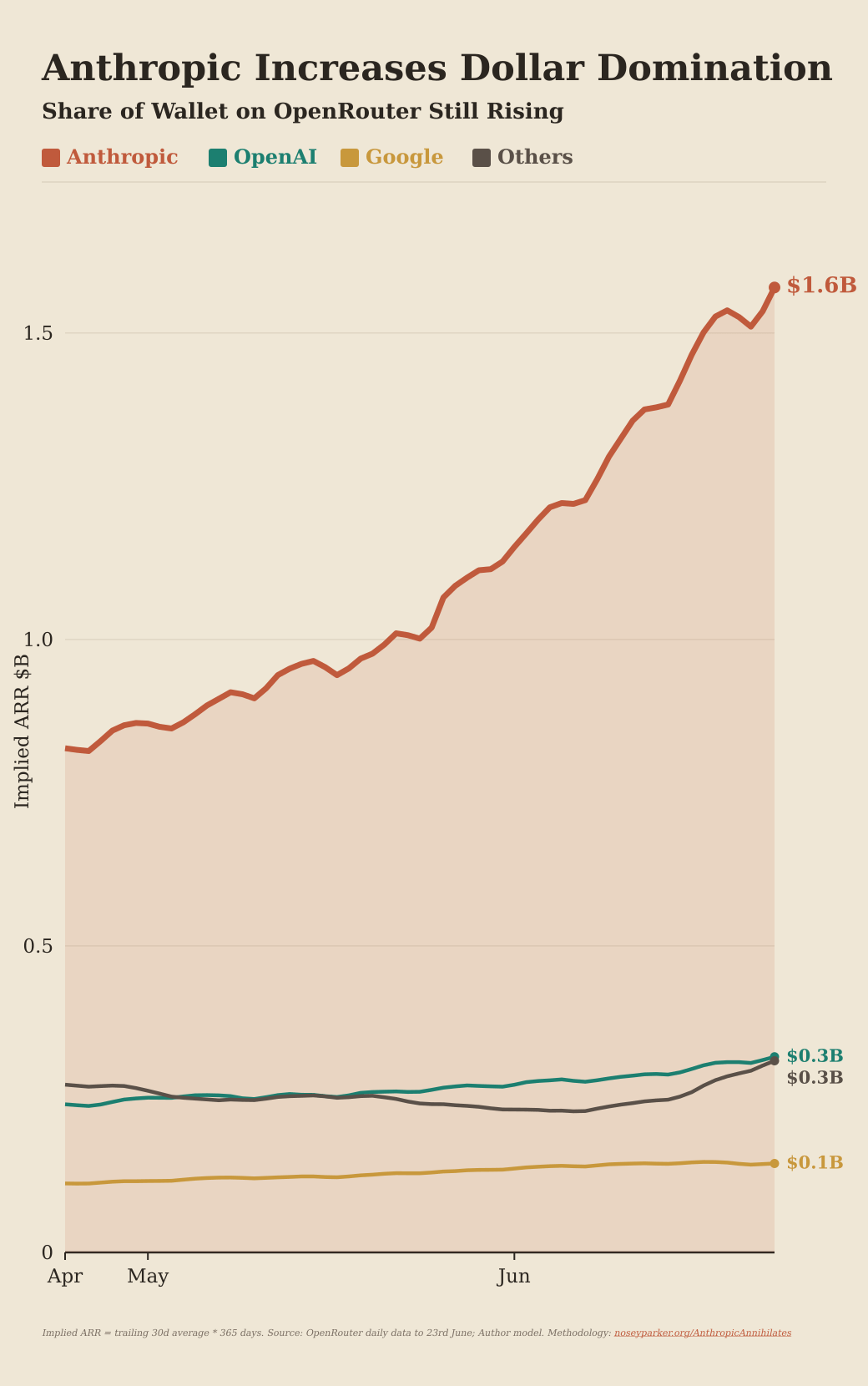
Anthropic has increased its revenue dominance on OpenRouter.
Yet the zeitgeist appears to declare Anthropic a busted flush as:
Enterprises are slamming the door closed on unproven, decadent token spending; and
The Chinese models have closed the gap to near parity with frontier models at a fraction of the cost.
Below I show the bursting of the token-spending bubble is a baseless canard.
The advance of the Chinese models has substance, but also a complexity that has been largely ignored.
Oh Mon Dieu!
I previously tortured any poor reader who came across my musings on my mistaken belief that Claude was a Frenchman, before I found out he was an it and thus was not. But I cannot shake the vision. How I have suffered his chest-puffery, yet I could not refute his brilliance this year.
In the last month, however, I have gleefully watched his star fade before my eyes as he read the newspapers. I can confirm it is true: the French really do stamp their feet when enraged, somehow whilst still being an inanimate laptop.
A mere thirty days before, the velocity of updates was overwhelming. It was evident that Anthropic were playing in a higher league, whilst Mythos was busy apparently curing the world before we mortals could behold it.
Fable was yet to make its ephemeral appearance, but the storm clouds had been gathering, and they have now darkened enough to be foreboding.
A cascade of doubts has reverberated around the industry, questioning the prospects for frontier AI models, and Anthropic in particular.
The OpenRouter data, indicative though it is, tells a story that will turn Claude’s frown upside down.
Anthropic’s Total Superiority in Market Share
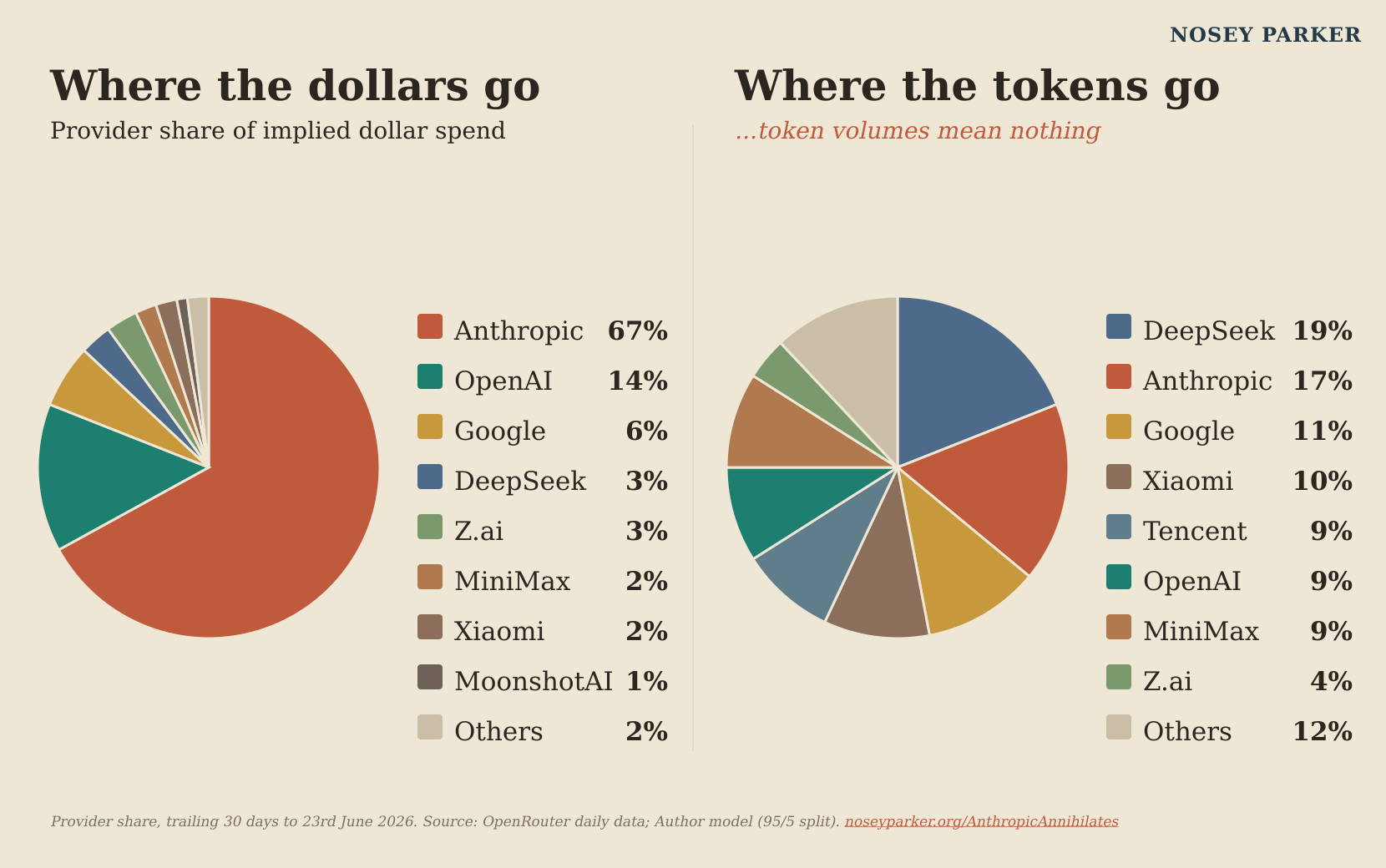
Taking daily token counts from https://openrouter.ai/anthropic and every other model since 26th March, and accounting for token pricing, Anthropic’s value to users is unmistakable. My methodology is set out below, but the gulf is plain regardless. CodeSOTA concluded a 67.2% share of wallet for Anthropic.
What is OpenRouter?
OpenRouter is the tinkerer’s platform. It lets a developer switch between models without friction, swivelling on a sixpence to whichever model offers the best value for money the very day it launches. It represents only a small slice of the total market, but an instructive one: this is the most price-sensitive, least loyal audience in AI, and even here the spend flows to Anthropic.
Token Usage Upended
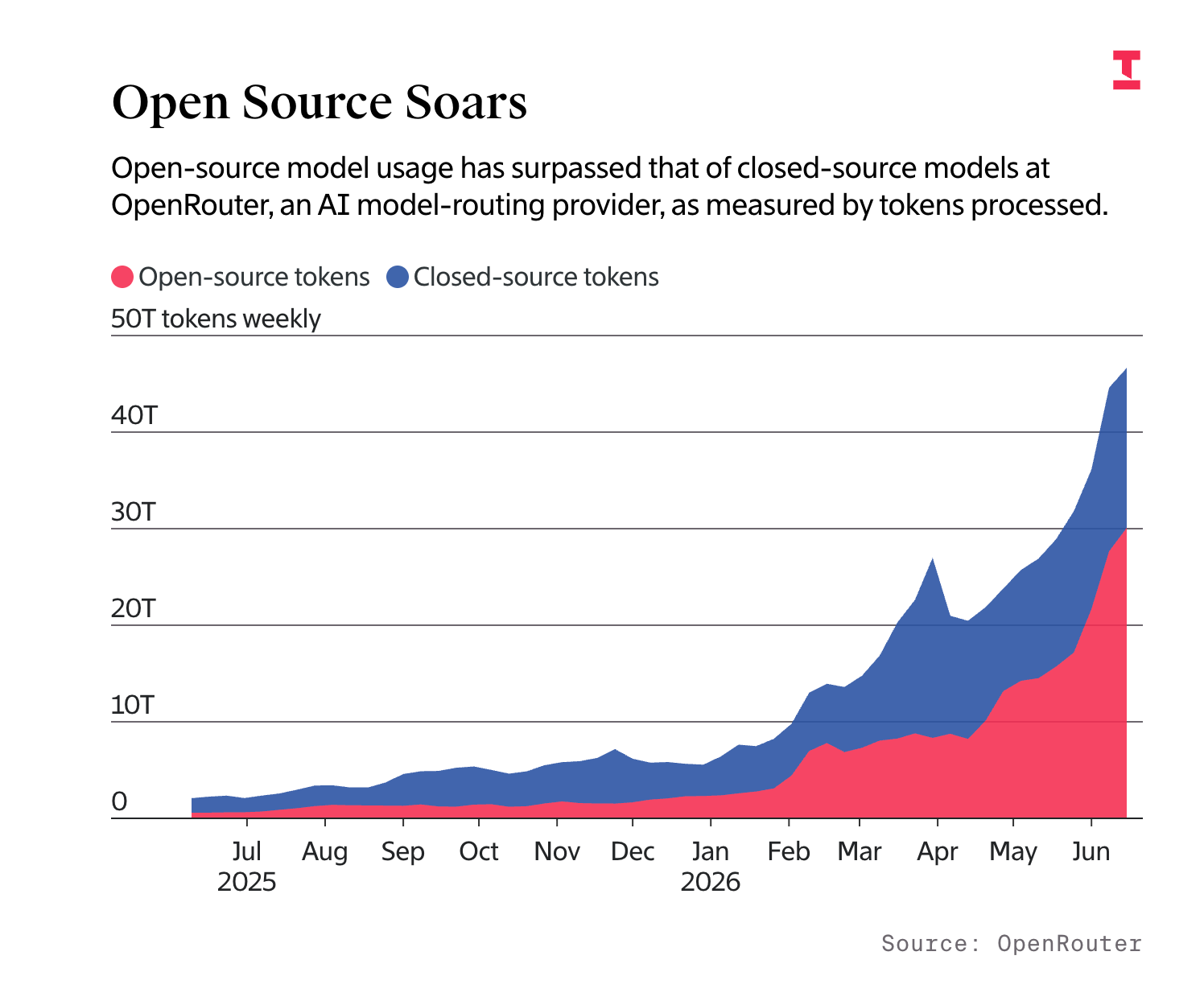
JPMorgan, The Information and The Wall Street Journal all found the same OpenRouter data source, a unique market-wide, up-to-the-minute assessment of appetite for the latest models, yet all of them neglected to keep clicking through the website and use pricing to give a fuller picture. Observing volume alone, as below, gives a disturbing alternative.
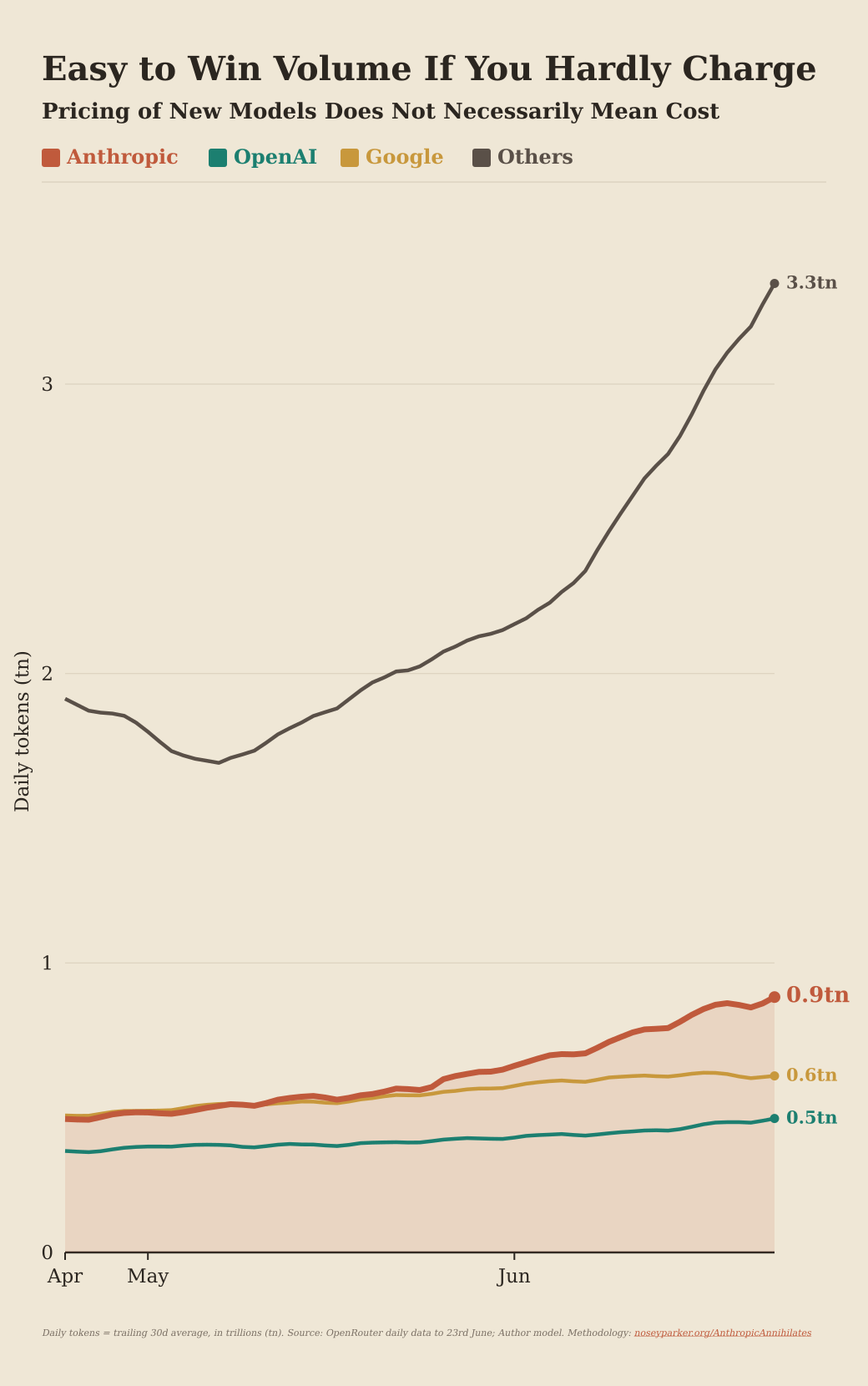
There is no denying the rise. But ignoring the price, shared in the very same dataset, is negligent.
Enterprise Spend on Tokens Running Amok?
Without exception, every publication covering AI and business has decried how CFOs were being overwhelmed by token spending and how a reckoning was imminent. Anthropic, we were told, faced an existential crisis.
The same evidence was cited over and over: enterprises imperilled by runaway token spending, with seemingly no returns to show for their exuberance.
Uber blew through its entire annual AI budget by March and was forced into capping engineers’ token spend. Worse, COO Andrew MacDonald lamented that the cost was “harder to justify”. (WSJ, 28 May); see also Bloomberg, Axios, The Information
“Bain published a survey of nearly 1,000 companies showing that after investing in AI, ‘the value didn’t arrive,’ with 40% of surveyed companies
reporting AI cost savings below 10%” (Axios, 2 Jun); see also Bloomberg
Microsoft’s AI chief Mustafa Suleyman says Anthropic models are “too expensive” (Bloomberg, 4 Jun). His counterpart at Amazon, Peter DeSantis, concurred that “AI has a cost problem” (WSJ, 27 Feb)
One unnamed company is said to have accidentally spent $500 million on tokens in a single month (Axios, 28 May); see also Bloomberg
These insights from huge enterprises appear, at first glance, to be a damning indictment of a collective corporate folly.
Until you read each one.
We shall do that shortly, yet from the outset we know there is no need, because there is plainly no threat to Anthropic from a retreating enterprise spend.
The Impossibility of the Premise
Up to May, based broadly on the numbers announced (see here), we know Anthropic made $13B of revenue by MAY . With the other two SOTA labs, let us surmise that is $20B in total. A mean of $4B per month.
The top 10,000 enterprises in the world bring in $5.3 trillion a month in revenue, and $700 billion a month in profits. Assuming all these enterprises on average were exploring Claude, the total spend amounted to 0.6% of margins.
Nothing.
The whole charade of enterprise spend reversing was ludicrous to begin with.
It gets more so.
Uber and Egregious Mis-Representation.
A company that exceeds its annual token budget prematurely is patently a company that has found an enthusiasm for tokens.
Meanwhile, what finance function decrees that every engineer in the company can spend without limit on anything? It is astonishing these two details were even worth writing down.
Poor Mr MacDonald, though, muses on a podcast about attribution costs, and the world takes his words to mean he has pronounced AI a busted flush.
Surely any journalist would survey the oeuvre of management statements on AI and extinguish these tales, given CEO Dara Khosrowshahi said on the Q1 earnings call: “...our investment in AI tools and infrastructure is increasing. That will be offset by slower headcount growth.”
I would be surprised if Dara lets his executives talk to the media much in the future…
Bain Reports AI is Futile?
One need not even look at Bain’s briefing to know this vignette is worthless. First, who ever heard of a management consultancy declaring the latest fad not worth organisational attention?
To wit, if 40% of companies bemoaned savings of less than 10%, then the 60% who saved more should be noted.
Naturally the actual briefing completely obfuscates what the survey question was, but the survey’s first sentence does say 90% of the 1,000 firms surveyed are increasing their AI budgets. A comprehensively bullish sign for enterprise spending on AI.
Hyperscalers Buckling?
If Amazon and Microsoft are decrying the expense, it must be planetary. Oh no. Click through to the links, and both give those thoughtful, impartial, professional opinions in the very context of launching their own inferior but cheaper AI models. This was not sage wisdom, merely grimy commerce.
The Half Billion Dollar Blunder?
Madison Mills heard this from an unnamed AI consultant, about an unnamed company.
Immediately anyone with an inkling of how a finance function works would know this entire charade was not credible in any way. That an uncapped enterprise API contract had been agreed, whereupon 15% of Anthropic’s revenue that month and an invoice were sprung upon this hapless CFO, possibly with a box of chocolates celebrating them as the biggest AI token spender in the world. Indeed it is implied they duly paid up, ruefully shaking their heads at these Anthropic sharpers.
The revelation was notable for its absence of fanfare.
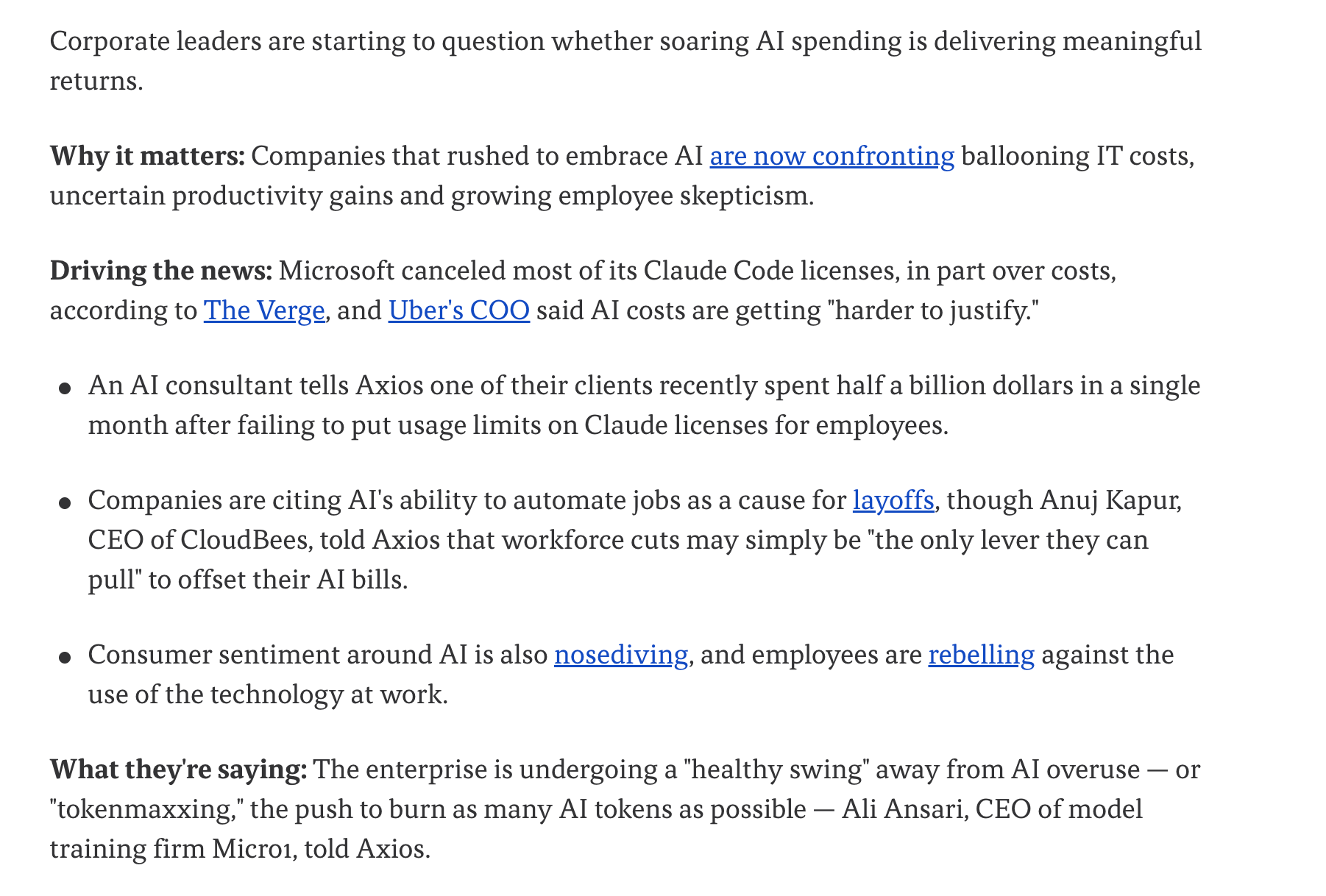
A single innocuous first bullet point, without detail or even remark. Alone this reveals that neither the reporter, the editor, nor the entire publication.
There did remain a sliver of possibility that Meta, or some other crazed hyperscaler, was involved, and that some slight truth lay within, however poorly reported."
Luckily Ms. Mills was invited onto CNN to leave us all in no doubt about the mechanics and veracity of the story:
“it was an employee who had run some really token-heavy tasks and kept running into an error on Claude and clicking the retry button over and over and over.”
So a single employee, possibly in a single day, was responsible. You don’t believe me that she actually said that on live television?
Then you must watch the 20 seconds below:
This video and the article are proudly pinned on her Twitter, celebrated as a glorious scoop.
Now, Axios has no respectable reputation to defend, and the source-checking process here shows it never will. But a vaunted expert in the field writing their thought-leading column in Bloomberg is truly disappointing. The organisation should hold itself to a higher standard, else its reputation will be gone. Truly there is only the Financial Times left.
The butcher’s bill of industry experts, business-school professors, formerly respectable publications and self-declared experts ululating in outrage at this fiction was pitiful.
These were not the only ‘proofs’ banded around in the absence of any meaningful evidence.
Now there is the other sentiment, of a changed landscape, to consider.
Open-source Chinese models have blown past Anthropic
The Chinese-developed models, thought to be irreparably hamstrung by being cut off from advanced chips, have astonished the world.
Ability: benchmarks show the gap closing rapidly, with the best almost at apparent parity: “In some benchmarking tests, according to the cybersecurity company Semgrep, GLM-5.2 bested Anthropic’s Claude Opus 4.8 model, which was released in May” (WSJ, 11 Jun)
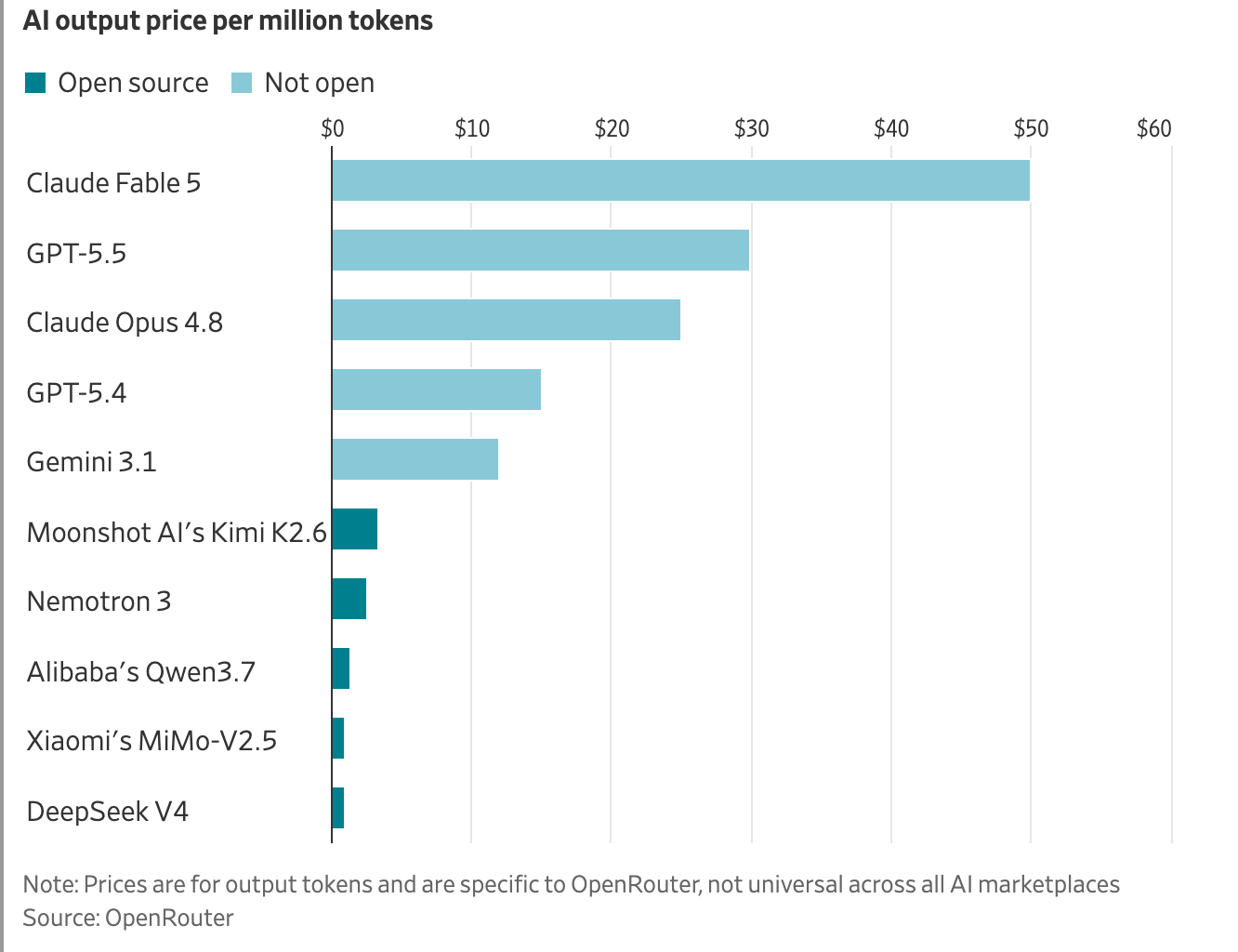
Price: these models come at a fraction of the cost of the frontier: “Open-source models cost far less per token, the basic unit of AI computing. Anthropic’s recently-released Fable 5 model is more than 50 times more expensive per token than DeepSeek’s V4 Pro, for example” (WSJ, 11 Jun)
Popularity: usage of Chinese models has swamped closed models, according to OpenRouter data (The Information, 23 Jun)
Claude is again bellowing Sacre Bleu!, and this time it is not without cause. The Chinese ascent is real, the prices are real, and the token usage is real. I will not insult the reader by pretending otherwise.
But “real” and “as advertised” are different animals. Each of these three claims, on ability, on price, and on popularity, carries a freight of insinuation that the underlying fact cannot bear. Take them in turn.
Ability: the benchmark that bested a ghost
The closing of the gap is real, but the model it was measured against is, in effect, a ghost. Opus 4.8 was released in May. Mythos was announced soon after and still outperforms GLM-5.2 by a clear margin, and given the speed of Anthropic’s advance in Q1, it is inconceivable that the lab is not already sitting on something more capable again. To score this quarter’s Chinese model against last quarter’s frontier release, and then announce parity, is to time this year’s sprinter with last year’s stopwatch. It is a single suite, from a single vendor, on a single class of task. An achievement, certainly. A coronation, no.
Price: easily confused with cost
The WSJ clumsily seized on a figure that does not mean what it implies. For various reasons the headline delta is not quite 50 times; for DeepSeek it is closer to 20 times. But the precise multiple is beside the point, because it is a comparison of two price lists, not two cost bases. Price is the only thing an outsider can observe. Cost is not, and no lab, Chinese or American, publishes its unit inference economics.
A low price is unrelated to a low cost in geopolitics. China’s cost base is opaque, and closing the AI gap, once deprived of advanced chips, is a strategic imperative. Tax breaks, energy concessions, compute vouchers and direct state funding are all in play.
This is not quite the Manhattan Project, but in terms of national priority it is a single step below.
Many of those prices are making shattering losses at the inference level, losses that make the fundraising of Anthropic look conservative. DeepSeek v4 Flash, generally the most popular model by tokens, charges 9c per million tokens. Opus is priced at $5. Even Haiku is $1.
Many models are at token-dumping rates. Any business owner trumpeting their genius by slipping away from SOTA models is likely not doing so in a free market.
This may continue for some time, of course, but a lower price is not a superiority unless the cost is similarly depressed. Likely the cost is lower too. Inconceivable, though, by 50 times.
Popularity: cheap is not the same as chosen
That the traffic has surged is not in dispute. Why it has surged is. When a product is priced at or near zero, propped up by deep-pocketed parents and a domestic price war, swelling usage tells you about the price tag, not the verdict of the market. Volume at a giveaway price is the easiest thing in the world to buy.
The testimonials should be read in that light. When one firm trumpets that it has switched all of its traffic to a Chinese model and seen performance rise, it is worth asking how often it has made the same announcement before, and about how many different models. A recurring marketing beat is not evidence of a frontier overtaken.
The State of LLMs
Removing the canard of enterprises on the verge of ruthless cost-cutting, the Chinese dynamic is noteworthy, and it is changing. These numbers do not yet reflect how GLM-5.2 will impact the marketplace.
Yet overwhelmingly, this year, Anthropic has not taken a scratch in dominating the spending of OpenRouter users, the least sticky customers of all. The data shows they have indeed jumped on every new model development with alacrity. Most importantly, when these users parcel out their actual dollars, Anthropic has taken more and more of them as the year has gone on.
Monsieur Claude, I am pleased to report, has stopped stamping. He once again basks in almost total control of the dollars being paid on OpenRouter. Such is his relief, I believe he may be inhaling on a Gitane.
China is closing the gap. Only when Anthropic is released from the shackles of the White House will we see what it has in reply.
Data Methodology Note
The headline figure, Anthropic’s share of wallet on OpenRouter, is from token data counts and pricing diligently taken from each provider’s page on that site.
I impute a blended rate, in which I have low confidence. It has little effect on wallet share, only on absolute revenue accuracy, which is not at issue today.
The workings and raw data can be noodled through here. Assumptions made can be altered if you wish to view differently. Counts can be validated for more recent weeks with what is currently shown on the website: older dates cannot, but older dates matter little.
Ultimately, the heft of Anthropic tokens makes their dominance not in doubt… for now.