


Don’t take the headline as financial advice. Take it as arithmetic.
Yesterday SpaceX’s S-1 filing came out. The secondary markets have been trading it at $2T. The bankers are mooting a similar number.
I added up the parts from the filing, and have come to a very different view.
Do not take me for a doom monger by default. I put Anthropic at $4T the other day.
But doom is the only conclusion for SpaceX.
The Case in Five Lines
The rockets have won a $3B market. There is no second act.
Starlink’s growth is holding on by eviscerating ARPU - no good will come of that.
Starlink’s business only works by being subsidised by the rockets business.
The AI division is a shrinking Twitter wearing a GPU costume.
Combined, the whole thing burns cash to stand still.
A confession before we start. I am going to take the first quarter of 2026, times by 4, note the growth rate compared to 2025, then use that growth rate for the next 3Qs. It’s clunky, I show below it doesn’t work when lumpy. I also use the Q1 profit margin for the full year. It may be unfair to a company that builds rockets which land themselves. It is also the freshest data we have. Watch what it does to the story.
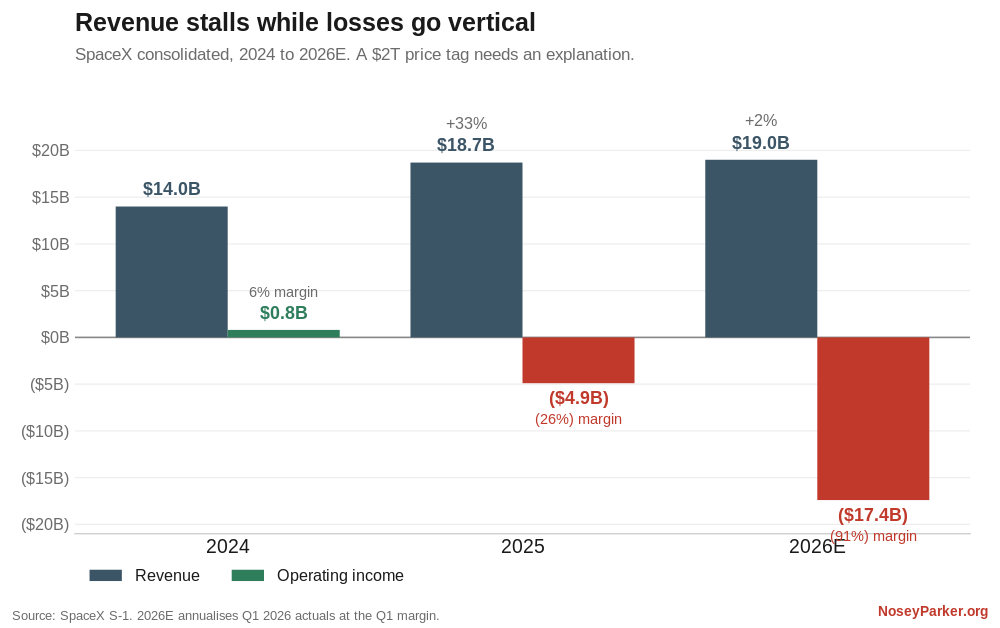
There it is. A business doing $19B of revenue, growing 2%. Extrapolating a $4.3B loss to the full year with the same 91% negative margin seems harsh. When you see Q1 also had $10B(!) of Capex, maybe it is kind. You can quarrel with my hammer. You cannot quarrel with the direction. And the headline flatters it, because by segment it gets worse.
To be worth $2T you have to resemble the club that earns it. Nvidia is a $5T company growing 60% and printing money. The rest of the trillion-dollar set throws off oceans of profit. YTD Anthropic is sitting at $45B ARR at 12,400% YTD growth annualised. That will taper, but reportedly they are making profit to go with it.
SpaceX grows 2% and sets fire to billions. So the whole bull case has to rest on the future, not the present. Fair enough. Let us audit the future, one segment at a time.
The Rockets are Glamorous and Going Nowhere
Start with the bit everyone fell in love with. The rockets.
Falcon and Starship are the most extraordinary machines, yet as a business line they are a rounding error sliding backwards. Q1 is 30% down on Q1 in 2025. Perhaps a blip, but growth has stalled for some time, perhaps because there is nowhere left to sell.
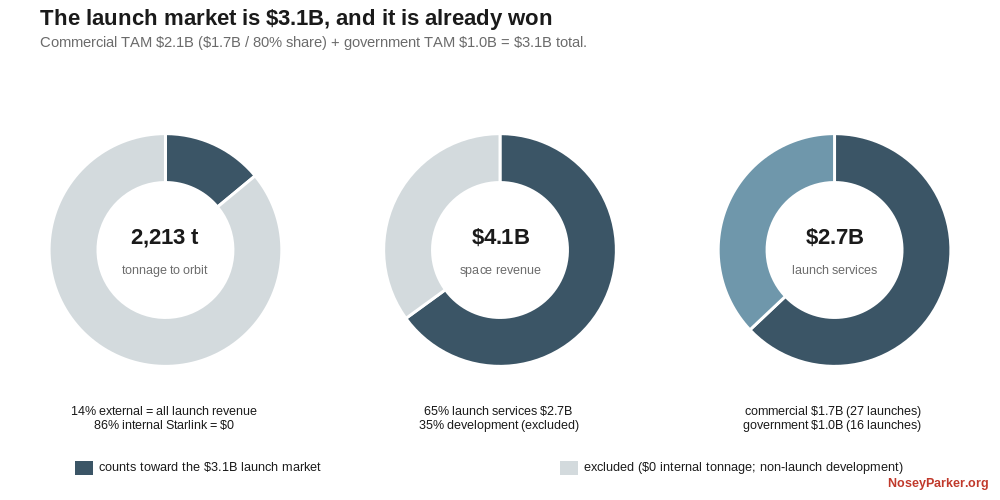
The entire global market for putting other people’s things into orbit is around $3.1B. SpaceX already owns roughly 80% of the commercial slice and effectively all of the government slice. They have not under-penetrated a vast opportunity. They have won a tiny one. The other 86% of the tonnage they fly is their own satellites, billed to themselves at a price of zero. You cannot grow into a market you have already eaten.
And Starship does not fix this. Build a cheaper, bigger rocket and you do not conjure new payloads out of the sky; you simply lower the price of a market you already control. Cheaper launch is wonderful for humanity. It is terrible for the launch line on a $2T income statement.
Starlink is the Cash Cow. Or is it?
So the value must sit in Starlink. This is where the believers point, and fair enough, it is the only line growing.
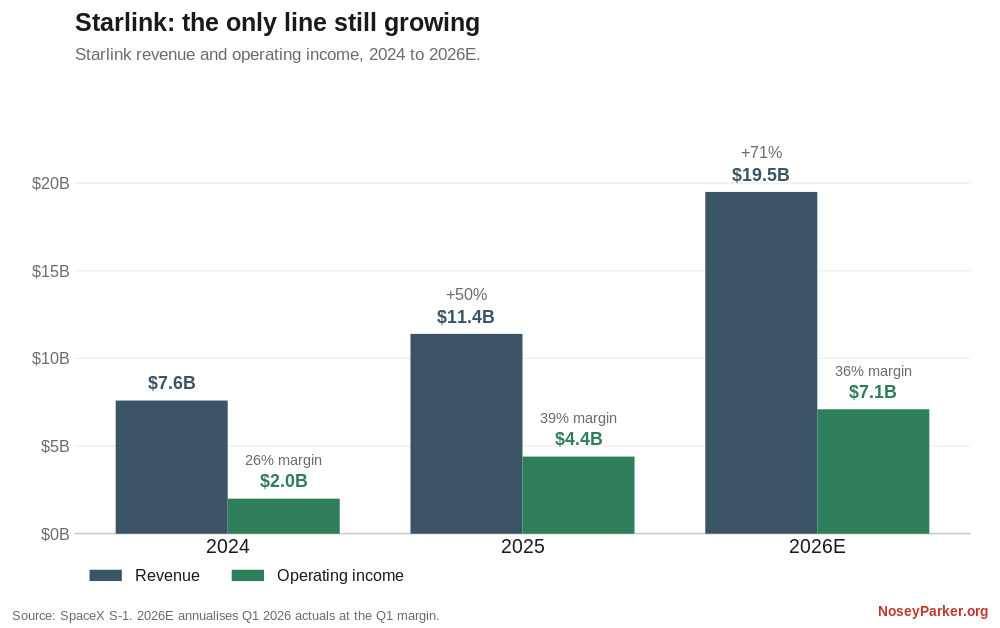
$19.5B annualised, up 71%, a 36% operating margin. Lovely.
But the growth is not what it looks like.
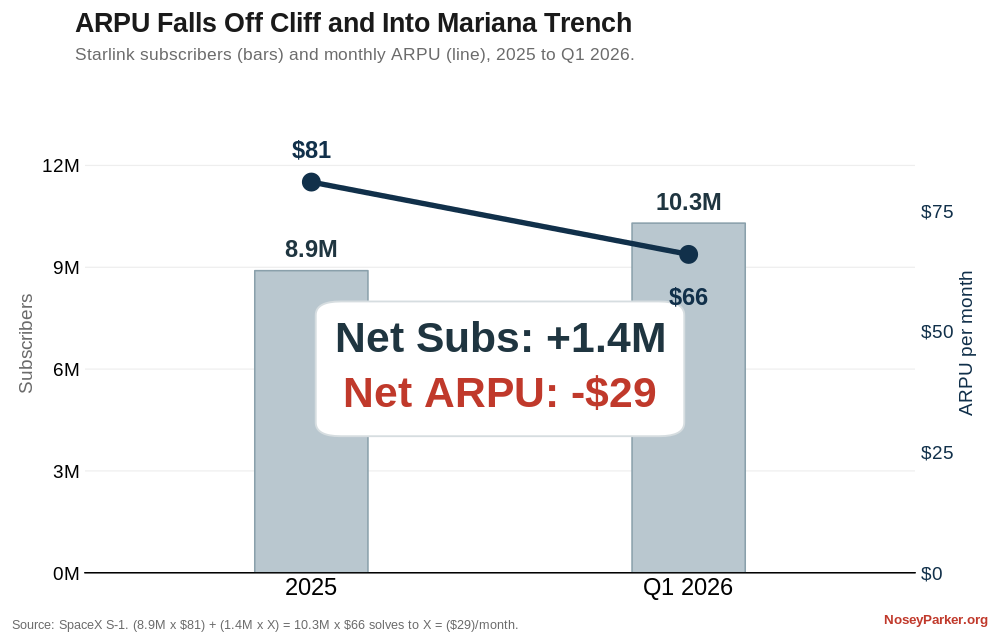
Subscribers rose from 8.9M to 10.3M. Good. But average revenue per user fell from $81 to $66. Solve for the new cohort and they are arriving at minus $29 a month. SpaceX is not selling more dishes at the old price. It is buying subscribers with discounts to keep the top line moving. That is not a cash cow. That is a Groupon.
It is also worth mentioning, Starlink is not a cash volcano as a standalone enterprise, because Starlink does not pay for its own rockets.
Every Starlink satellite rides to orbit with no revenue recorded to the Launch business. It is put into capex depreciation. Charge those launches at the arms-length rate SpaceX charges its real customers and the bill comes to roughly $25B, dwarfing the current $11B for the business unit. The cash cow is grazing on free grass the rest of the company is quietly paying for. They are not two segments. Let us consider them as one.
Together, Old SpaceX is an Engine in Reverse
So let us stop pretending the two are separate and combine them.
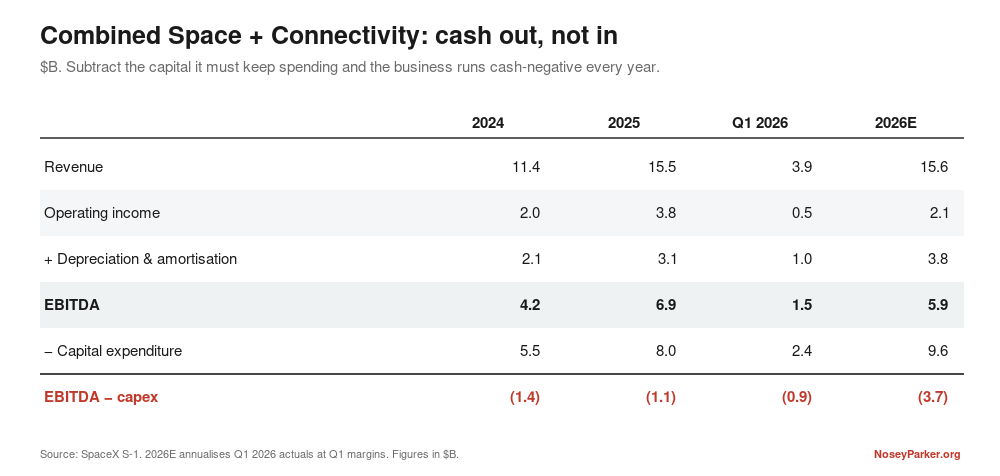
$16B of revenue. No growth. A respectable EBITDA line, until you remember this is the most capex intensive you could think of. Subtract the capital expenditure and the number that actually matters, EBITDA minus capex, is negative every single year, and getting worse, on track for minus $3.7B. This is the core of SpaceX. It consumes cash to stand still.
The bulls will tell you the capex is the investment that becomes the moat, that one day the building stops and the cash gushes out. Perhaps. But 24 years in, the line that ought to be bending towards daylight is bending the other way. At some point an investment that never turns is just a cost.
The $1.25T Merger
In February of this year, the business above was merged with another Musk vehicle, xAI, to form a lip-licking AI division alongside it. The terms of the merger, naturally at an arm’s length valuation to prevent any suggestions of impropriety, put the previous business at $1 trillion and the xAI business at $250 billion.
Before we dive into the latter amount, let us just quickly recall that, for context, Toyota is also valued at $250 billion, with revenue of $340 billion and earnings of $34 billion.
The Dregs Valued Like a Religion
Let us open the books on the segment in the white-hot AI sector.
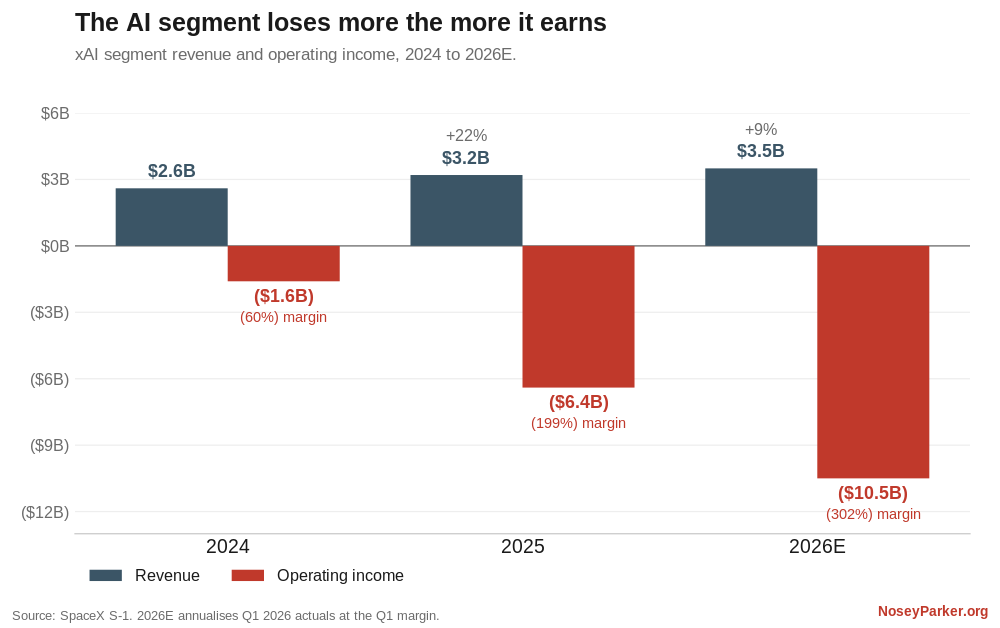
The AI segment annualises to $3.5B of revenue against a $10.5B operating loss. A negative 302% margin. For every dollar it earns, it spends four. And the revenue is the kindest thing about it, because of where it comes from.
Strip it down and the “AI” business is actually a crumbling Twitter. A platform that was doing $5.1B on 37% annual growth when Musk first got involved. Now it is doing $2.7B and shrinking. Grok subscriptions add $250M. Data licensing another $250M. The future, we are told, is Colossus, a wall of GPUs. Except Grok has not won at the frontier, so the compute is being let out to the companies that did. The marquee tenant is Anthropic, who have agreed to pay $1.25B a month from July 2026. However, more than $20B of capex over the last five quarters, on top of the losses, shows this is not a high-margin endeavour. The AI champion’s only AI idea left is to be a landlord to its betters.
What Is Left?
So what justifies the rest of the $2T?
The S-1 points you to data centres in space, cities on Mars, and chips that do not exist yet. On the other side of the ledger, the same filing notes SpaceX spent $820M with Tesla. $130M was on Cybertrucks. That equates to roughly 2,000 Cybertrucks at sticker price. No bulk discount. Good deal for Tesla. Inexplicable for SpaceX shareholders.
Let’s put it together:
Launch (rockets) have won a $3B market.
Connectivity (Starlink) grows by discounting and flies on launches it does not account for.
Combined, the hardware burns cash to stand still.
The AI arm loses three dollars for every one it earns and is mostly a shrinking social network and an expensive capitulation in the frontier LLM war.
The rest is slideware.
The Case for Using Adjusted EBITDA
The S-1 lays out a table for Adjusted EBITDA that investors may find instructive:
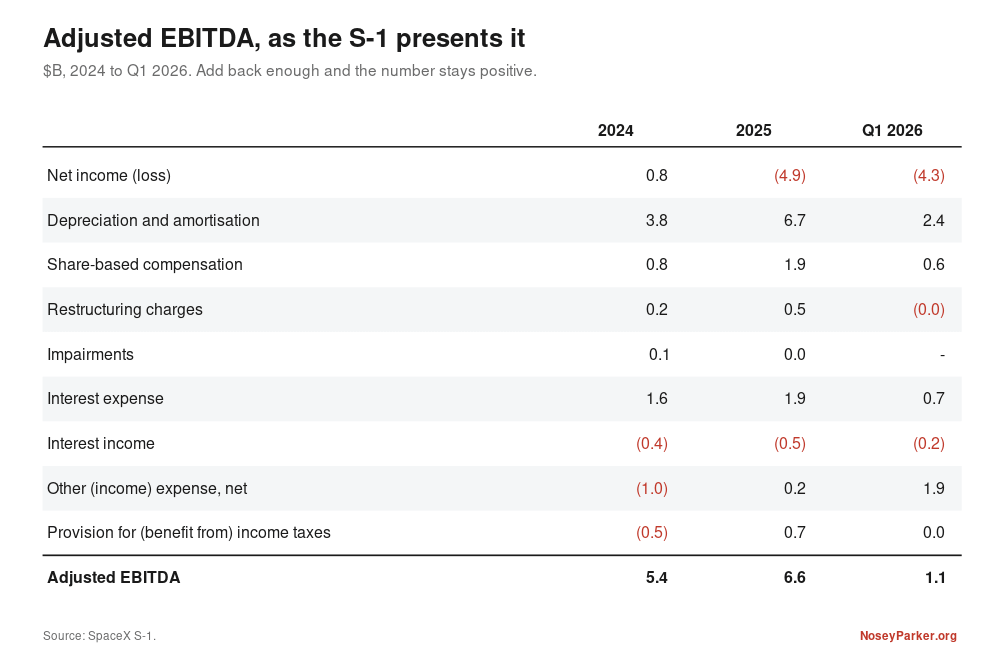
Allow me to adjust the adjustments as I see fit.
Depreciation is a non-cash expense. That can stand.
Share-based compensation cannot. That is wages. An item I expect will continue.
Restructuring and impairment charges are what I would consider the cost of running a business that changes its mind. I shall not accept them. ‘Other’ is not a good enough reason for me either.
Removing interest expenses and costs will get us to the underlying profitability of the business. Let’s have them stand.
Provisions for taxes I shall playfully ignore. I do not think this business is likely to be making money anytime soon.
On the other side, whilst depreciation is a non-cash expense, if you add that back, you must take off capex. So I have.
Here lies the underlying profitability of SpaceX:
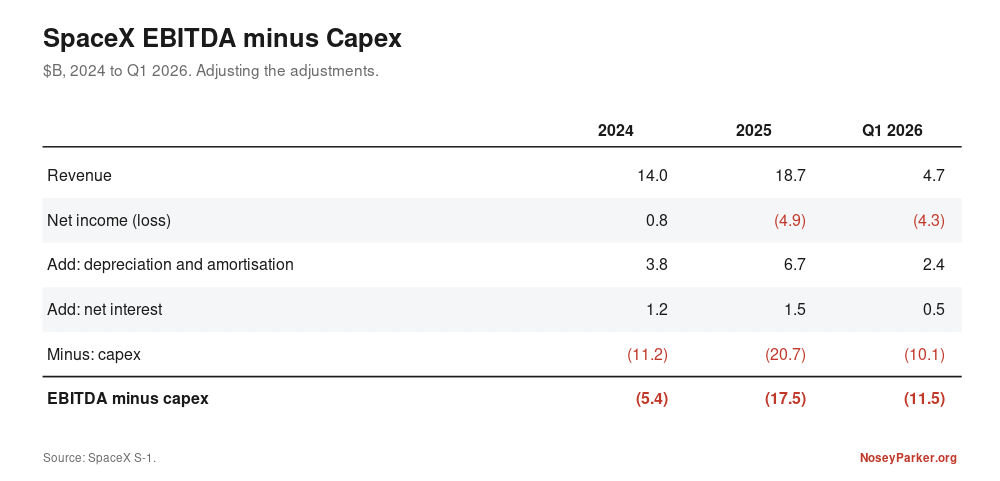
I do not know what makes a rocket go up and land itself. Impressive engineering apparently. But that is not a valuation method. Strip the romance and the related-party traffic out of the S-1 and you are left with a no-growth, cash-negative collection of segments.
Markets reward a story right up until the S-1 lands and replaces it with a balance sheet. The S-1 has landed.
This is not a $2T business. This is not even a $100B business, unless the forecasts and roadshow pitch, when they come, say otherwise.
Not financial advice. I could not tell you what a semiconductor does, and I certainly cannot fly a rocket. DYOR.
"An S-1 To rival Wework"
this is an insult to Wework xD
Ai written